Reviewed by Dr. Benjamin Wright, board-certified orthodontist
The American Association of Orthodontists recommends that children have a first orthodontic check by age seven. Most children who are seen at that age need nothing yet. The point of the visit is to find the small number of problems that are far easier to correct while the jaw is still growing. At Wright Orthodontics these evaluations are done by Dr. Benjamin Wright, a board-certified orthodontist, and they are complimentary.
Parents usually arrive with the same two questions. Why so young, and does my child really need braces at seven? Seven is when the first permanent molars and incisors are in, which is the earliest a specialist can read how the bite is developing. And no, most seven-year-olds need no treatment at all.
Why Age Seven?
By about age seven a child has a mix of baby and permanent teeth. That mix is what makes the evaluation useful. Dr. Wright can see how the permanent teeth are erupting, whether the upper and lower jaws are growing in proportion, and whether there is room for the teeth still to come.
Finding a problem at seven does not mean starting treatment at seven. In most cases it means we know what to watch and roughly when to act.
Phase One and Phase Two
Early treatment, also called Phase One, typically begins around age eight or nine. It is a limited course of treatment aimed at a specific problem rather than a full alignment of every tooth. The goal is to correct the growth of the jaw and certain bite problems, such as an underbite, and to make room for permanent teeth so that fewer of them need to be extracted later.
Phase Two usually begins around age 12, once most permanent teeth are in. This is the comprehensive phase, with full braces or clear aligners, that produces the final alignment.
Not every child who has Phase One needs Phase Two, but most will. Anyone who promises you otherwise before treatment begins is guessing.
What Early Treatment Can Prevent?

Most children lose all their baby teeth by about age 12, and by the end of the teen years the jawbones harden and stop growing. That window is the reason early treatment exists.
Problems such as crowding, excess spacing, jaw growth problems, protruding teeth, and bad bites can be inherited. They can also be caused by injury to the mouth, by early or late loss of baby teeth, or by thumb-sucking. Treated while the jaw is still developing, some of these can be guided rather than corrected after the fact. Treated in adulthood, the same problems often take longer and may involve extraction or jaw surgery.
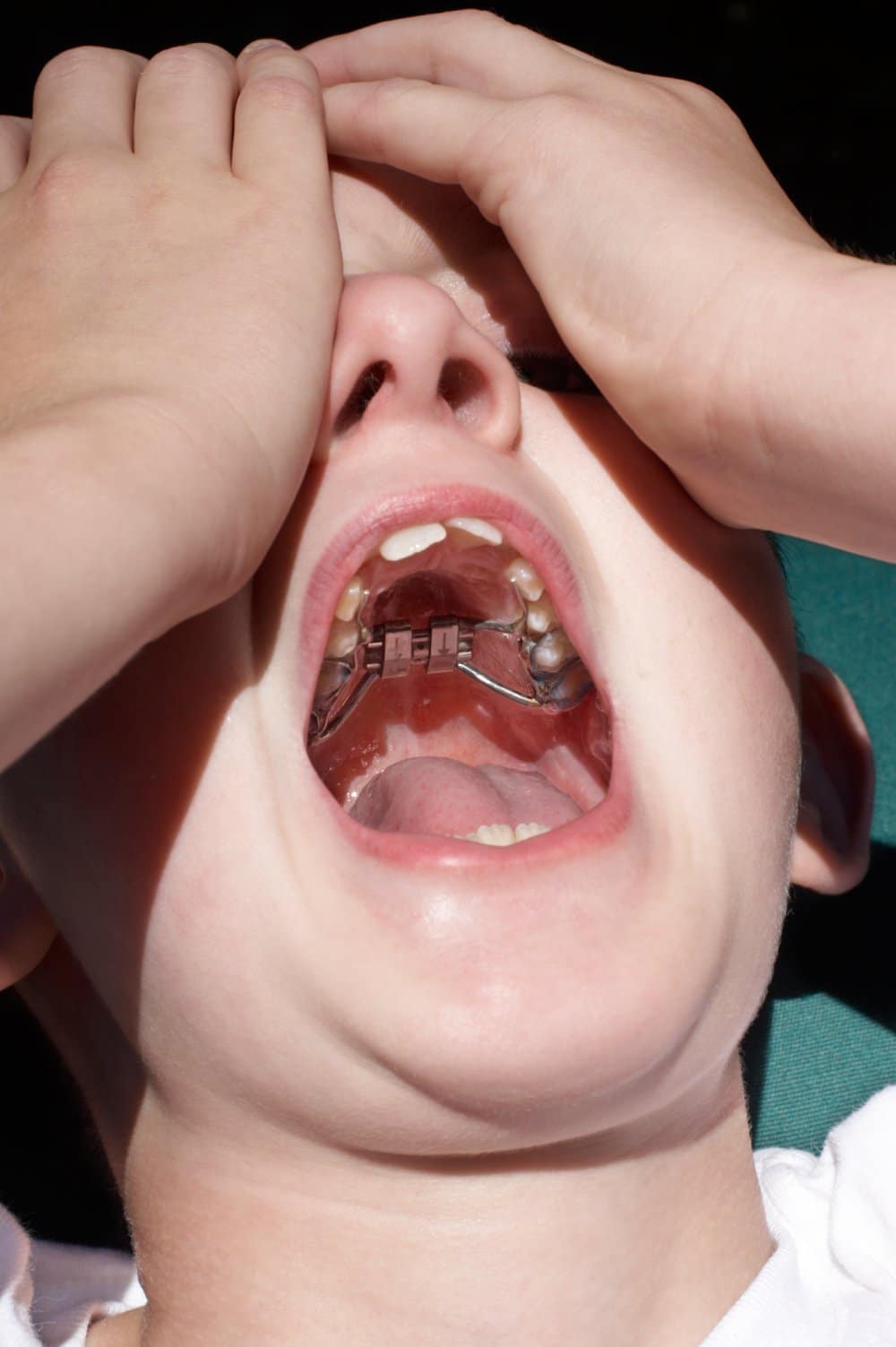
A palatal expander is the most common early appliance. It widens a narrow upper jaw gradually, which creates room and can correct a crossbite while the bones still respond to it.
Signs Worth an Evaluation
Bring your child in sooner rather than later if you notice any of the following.
- Early or late loss of baby teeth. Children typically start losing teeth around age five and have all their permanent teeth by about 13.
- Difficulty chewing or biting.
- Mouth-breathing.
- Thumb-sucking that continues after age five.
- Speech difficulties.
- Teeth that protrude, with the top and bottom teeth extending away from each other.
- Teeth that do not meet normally, or at all.
- A jaw that shifts when your child opens or closes their mouth, which suggests a crossbite.
- Crowded front teeth at age seven or eight.
Your family dentist may also refer you. No referral is needed to see us.
When the Answer Is to Wait
Sometimes the right answer is to do nothing yet.
When this is the case, we say so and put your child on an observation/ growth check instead. These visits are short and complimentary. They are normally every six to twelve months, so we can start the moment the timing is right.
Frequently Asked Questions About Early Orthodontic Treatment
At what age should a child start seeing an orthodontist?
By age seven, per the American Association of Orthodontists. That is when enough permanent teeth have arrived for a specialist to assess how the bite and jaws are developing. Most children seen at seven need no treatment yet, and the visit at our office is complimentary.
What is the difference between early and regular orthodontic treatment?
Early treatment, or Phase One, is limited and targets a specific problem while the jaw is still growing, usually around age eight or nine. Regular comprehensive treatment, or Phase Two, aligns all the permanent teeth and usually starts around age 12. Early treatment does not replace comprehensive treatment; it makes it simpler.
How early is too early for orthodontics?
Normally we like to wait for some of the adult teeth to erupt (age 7). There are always exceptions and that is why our evaluations are complimentary.
Will my child still need braces after Phase One?
Often, yes. Phase One corrects a growth or bite problem while it is correctable; it does not straighten every permanent tooth, because most of them have not arrived. Phase Two is usually more straightforward because of Phase One.
What happens if we just wait until all the permanent teeth are in?
For most children, nothing bad happens, and that is exactly the plan we recommend. For a smaller group with jaw growth problems, severe crowding, or a crossbite, waiting misses the window when the jaws / teeth could have been guided into an improved position. Missing this opportunity for correction may not allow us to get as good of a final result.
Book Your Child's Complimentary Evaluation
Call 410-544-0072 or request an appointment online. Our cost, insurance, and financing page explains how insurance and payment plans work. Wright Orthodontics is at 479 Jumpers Hole Road, Suite #203, Severna Park, MD 21146, a quarter mile from Severna Park Middle School. We see children from Severna Park, Millersville, Crownsville, Arnold, Severn, and Pasadena. We also serve Cape St. Claire.