iTero Digital Scan and 3D Imaging: Orthodontic Technology in Severna Park

Reviewed by Dr. Benjamin Wright, board-certified orthodontist

Two pieces of equipment do most of the work behind an accurate treatment plan here: a digital intraoral scanner and a cone beam 3D imaging system. One replaces the putty impression. The other shows Dr. Benjamin Wright, a board-certified orthodontist, what is happening inside the bone rather than only on the surface.

Neither is a gadget. Both change what can be diagnosed and how comfortable the appointment is.

Technology Is a Tool, Not a Treatment Plan

iTero Digital Scanning

A hand-held wand captures the shape of your teeth and gums directly, with no putty and no radiation. A full scan usually takes two to three minutes, and it can be paused and restarted as often as needed.

Cone Beam 3D Imaging

One twenty-second scan in an open, upright machine shows the teeth, roots, jaws, and joints in three dimensions.

Diagnosis and Judgment

Equipment does not straighten teeth. Diagnosis and judgment do, and those come from Dr. Wright's twenty-six years of practice and his board certification through the American Board of Orthodontics.

Equipment does not straighten teeth. Diagnosis and judgment do, and those come from Dr. Wright’s twenty-six years of practice and his board certification through the American Board of Orthodontics. What good technology buys you is a more accurate starting point, fewer uncomfortable appointments, and a plan built on what is actually there.

We also keep a diode laser in the practice for the small number of cases that need it, most often to expose enough tooth surface to place a bracket properly, to help a slow-erupting tooth through, or to even out a gum line after braces come off. Treatment usually needs only a topical anesthetic, and it is quick.

iTero Digital Scanning

If you had orthodontic impressions taken years ago, you remember the tray of putty, the gagging, and the wait. That is gone. We take a digital impression with an iTero scanner instead.
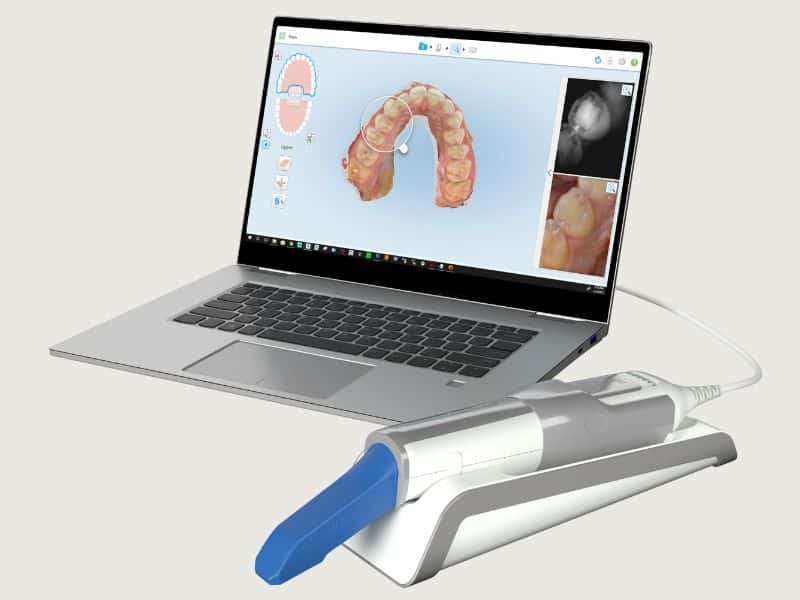
The scanner is a hand-held wand with an optical camera in the tip. It captures the shape of your teeth and gums directly, without any material in your mouth. There is no radiation involved. The scan can be paused and restarted as often as needed, which matters for younger patients and for anyone with a strong gag reflex.

A full scan usually takes two to three minutes. At the end of it, a precise three-dimensional model of your teeth appears on the screen beside you, and we can turn it, zoom in, and show you exactly what we are discussing. Patients understand their own bite far better when they can see it from angles a mirror never offered.

Accuracy is the clinical argument. Putty impressions could distort or tear, and a rejected impression meant repeating the whole unpleasant business. A digital scan is checked on screen while you are still in the chair. If a section is incomplete, we rescan it in seconds.

We use the scanner for Invisalign® clear aligners, where the aligner series is manufactured directly from the digital file, and for retainers, appliances, and treatment records. Because the file is stored, we can compare where your teeth are today against where they were at the start.

That comparison is more useful than it sounds. Progress in orthodontics is slow enough that patients rarely notice it week to week. Seeing the original scan beside the current one is often the moment a teenager decides the elastics are worth wearing.

Cone Beam 3D Imaging

A conventional dental X-ray is a flat picture of a three-dimensional problem. Our i-CAT cone beam system produces a full three-dimensional image of the teeth, roots, jaws, and joints. One scan takes about twenty seconds.
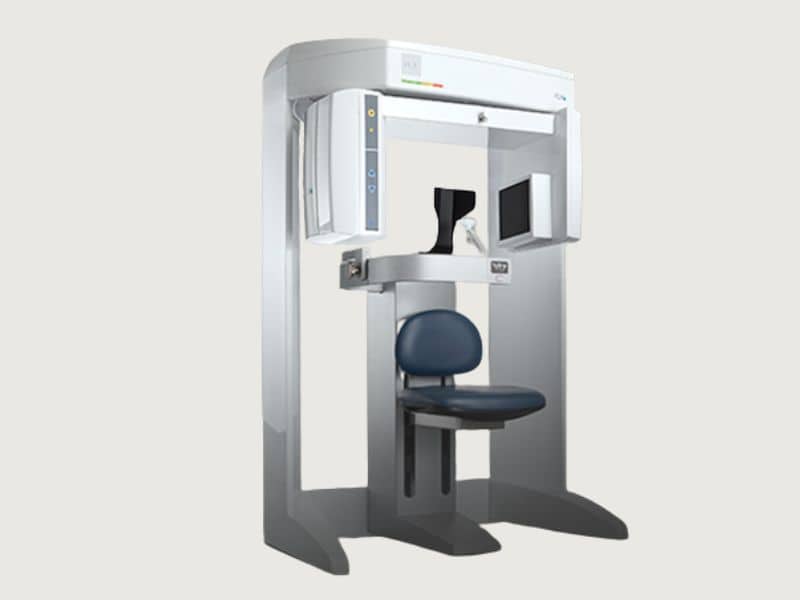
You sit upright in an open machine while it rotates around your head. There is nothing enclosed about it, and nothing touches you. For patients who find imaging stressful, that design matters more than the specification does.

What the scan shows changes decisions. We can see the exact position and angle of a root, which matters when teeth need to move through a narrow corridor of bone. We can locate an unerupted or impacted tooth precisely, including the canines that sometimes come in sideways, and plan around it rather than guess. We can assess the temporomandibular joints. We can see how much bone surrounds a tooth before deciding how far it can safely be moved.

A cone beam scan also delivers considerably less radiation than a traditional medical CT scanner. 

The images belong to you as much as to us. We put them on the screen and go through them, so decisions about extractions, surgery, or timing are made with you looking at the same evidence we are. When a case is being planned with an oral surgeon or your family dentist, we share the same files with them.

Frequently Asked Questions About Our Technology​

The scanner captures the same information optically, with no material in your mouth, and the result is more accurate because it can be checked and corrected on the spot.

The iTero scan uses light, not radiation, so there is nothing to weigh. A cone beam scan does use X-rays, at a considerably lower dose than a traditional medical CT scanner.

See It for Yourself

The simplest way to understand any of this is to be scanned. Call 410-544-0072 or request an appointment online for a complimentary consultation. How fees, insurance, and payment plans work is covered on our cost, insurance, and financing page. Wright Orthodontics is at 479 Jumpers Hole Road, Suite #203, Severna Park, MD 21146, serving Severna Park, Millersville, Crownsville, Arnold, Severn, Pasadena, and Cape St. Claire.